
Biblical Wealth Stewardship vs. Secular Wealth Accumulation

Money as a Master or a Servant
In the secular marketplace, wealth accumulation is often presented as the ultimate score: a tool to achieve personal security, luxury, status, and early retirement. For the secular founder, the primary question surrounding money is, “How much can I get, and how can I protect it for myself?”
For the Christian male entrepreneur, wealth carries a radically different meaning. Money is neither inherently good nor inherently evil; it is neutral power. It makes a poor master, but a remarkably effective servant.
Scripture provides a robust framework for managing financial resources that contrasts sharply with mainstream financial advice. True financial success as a kingdom business owner isn’t measured by net worth alone, but by faithfulness, generosity, and kingdom stewardship.
Ownership vs. Stewardship Mindset
The fundamental divide between biblical finance and secular finance comes down to a single question: Who owns the business and its assets?
- The Secular View (Ownership): “I built this company with my sweat, vision, and capital. The profits belong to me, and I have the sole right to dispose of them as I see fit.”
- The Biblical View (Stewardship): Psalm 24:1 states, “The earth is the Lord’s, and everything in it, the world, and all who live in it.” You are not the owner of your company; you are the manager (steward) operating on behalf of the Ultimate Owner.
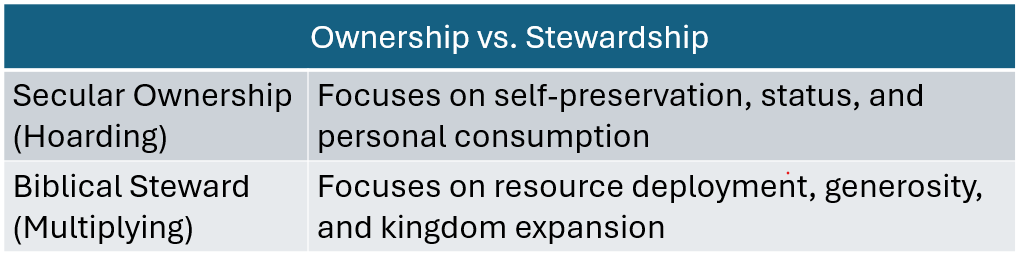
When you shift from an owner mindset to a steward mindset, financial stress decreases significantly. The pressure to preserve or grow the business doesn’t rest solely on your shoulders—it belongs to God. Your job is simply to execute with excellence and integrity.
The Parable of the Talents: Multiplication over Hoarding
In Matthew 25:14–30, Jesus tells the Parable of the Talents. The master entrusts different amounts of money to three servants before going on a journey. Two servants invest and double their resources, while one servant buries his talent out of fear.
The master praises the two who multiplied their assets, calling them “good and faithful servants,” but rebukes the fearful servant.
God expects Christian founders to actively multiply the financial assets placed in their care. Building a profitable, growing company is not unspiritual—it is an act of multiplication that creates jobs, solves problems, and generates resources for kingdom work.
Wealth as a Tool for Kingdom Impact
Secular financial planning often leads to hoarding—building a larger “barn” simply to feel safe. While prudence and emergency reserves are biblical (Proverbs 21:20), accumulating excess capital purely for personal comfort deprives you of the joy of generosity.
In 1 Timothy 6:17–18, Paul instructs wealthy believers:
“Command those who are rich in this present world not to be arrogant nor to put their hope in wealth, which is so uncertain, but to put their hope in God… Command them to do good, to be rich in good deeds, and to be generous and willing to share.”
Managing Capital for the King
When you view your company’s revenue and profits as resources entrusted to you by God, every financial decision—from executive compensation to reinvestment and charitable giving—takes on eternal significance. Build a business that prospers, and use that prosperity to advance God’s kingdom on earth.